
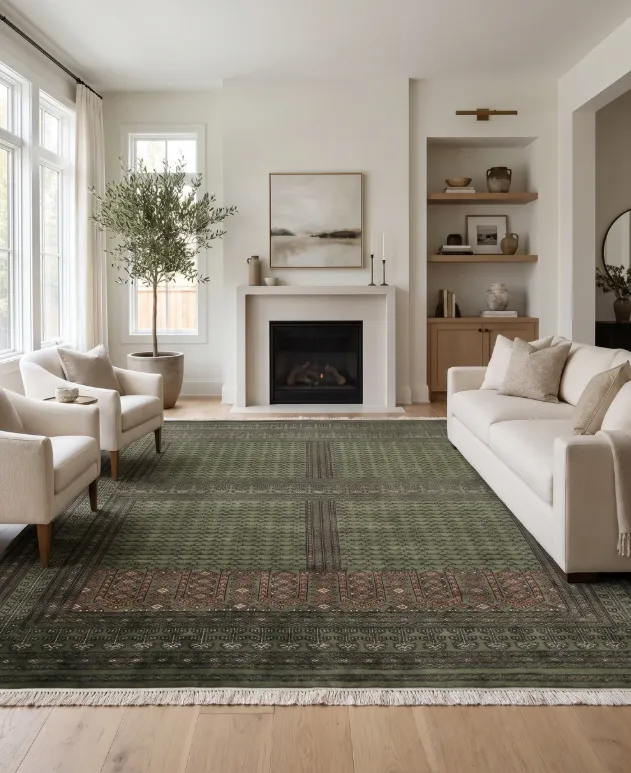
Green carpets are having a moment, but let’s be honest: most people still choose them as if all greens behave the same. They do not. A sage green carpet can look soft and almost neutral. An olive carpet can suddenly make a cream room feel warmer. A deep forest green carpet can look rich and grounded. An emerald green carpet can either feel luxurious or aggressively loud, depending on the room.
This is the problem with most advice around green carpets. It tells you green represents nature, calm, and freshness, then shows you a few nice colour combinations.
Useful? Slightly.
Enough before spending money on a large carpet? Not even close. The real question is not “Is green a good carpet colour?” It is “Which green will survive my room’s lighting, flooring and everyday mess?”
That matters in Indian homes because our rooms are not always blank beige boxes. We have cream marble, white vitrified tiles, yellow-toned lights, brown furniture, colourful curtains and sunlight that can change the appearance of a carpet dramatically.
And yes, green is increasingly relevant in current interiors. But 2026 design coverage points less towards one “perfect green” and more towards tonal variation, materiality, and how different shades respond to light.
So before buying a green carpet, understand this: the wrong shade can look dull, muddy or strangely artificial in your room.
Which Shade of Green Carpet Should You Choose for Your Room?
Choose the green according to your room’s undertones and natural light, not because a particular shade looks good in an online photograph. This is where buyers make their first major mistake.
They see “green” and decide based on whether they prefer dark or light colours. But the undertone matters just as much.
Some greens are warm and yellow-based. Others are cool and blue-based. The difference becomes obvious once the carpet is placed beside furniture and flooring.
Choose sage or muted green if your room is already visually busy
Sage usually works best when you want green without making the floor the centre of attention.
It can suit:
- Cream or off-white walls.
- Grey furniture.
- Light wood.
- Smaller bedrooms.
- Rooms with plenty of patterns already.
Sage is also one of the easier greens to live with because its grey undertones make it visually softer. Current 2026 coverage identifies nuanced greens as part of a broader move towards more complex, less flat colour choices.
Choose olive or moss green if your home has warm tones
Olive usually works better with:
- Indian marble and beige tiles.
- Teak or walnut furniture.
- Brass accents.
- Terracotta.
- Cream upholstery.
These greens contain warmer undertones and often feel more natural beside earthy materials.
Choose forest or bottle green if you want depth
Dark green carpets can work beautifully in larger rooms or spaces with good natural light.
But they need visual breathing space.
Pairing a dark green carpet with:
- Dark flooring.
- Heavy curtains.
- Dark furniture.
- Poor lighting.
can make the entire room feel heavy.
Choose emerald only when you want a clear statement
Emerald is not a safe neutral pretending to be adventurous.
It is a strong colour. Use it when the surrounding furniture is relatively simple, and you genuinely want the carpet to become one of the room’s main visual features.
The more saturated the green, the quieter the rest of the room should generally become.
Why Does the Same Green Carpet Look Different in Different Homes?
Because lighting and surrounding colours can change how green is perceived, sometimes more than buyers expect. A carpet that looks perfect in a showroom may look completely different at home.
This is particularly important with green because light can bring out different undertones. Natural daylight, warm LED bulbs, and cool white lighting can all change whether a carpet looks:
- Greener.
- Greyer.
- More yellow.
- Darker.
- More muted.
In rooms with strong sunlight
A lighter green may appear brighter and warmer during the day. Before buying, think about the afternoon light in your room, not just how the carpet looks at night.
In darker rooms
A deep green carpet can lose detail and appear almost black or muddy. In these spaces, a textured or tonal green can work better than a flat, solid dark surface.
In rooms with warm yellow lighting
Some olive and yellow-based greens can become noticeably warmer.
In rooms with cool lighting
Sage and blue-based greens can appear cooler and slightly greyer.
This is why current colour guidance repeatedly emphasises checking undertones and viewing colour samples in the actual room rather than relying entirely on digital images.
Never judge a green handmade carpet by one product photograph. Green needs to be understood in your room’s light.
Do Green Carpets Get Dirty Too Easily in Indian Homes?
Not necessarily. In fact, medium and deeper greens can hide everyday dust better than very light solid carpets, but the pattern and pile matter more than the colour alone.
This is where the “green carpet equals natural and practical” assumption becomes too simplistic. A pale sage carpet with a smooth, uniform surface can visibly show dirt. A deeper textured olive rug may be far more forgiving between cleaning cycles.
For homes with regular dust and foot traffic, consider:
- Medium olive tones.
- Moss green.
- Tonal patterns.
- Multi-shade designs.
- Textured weaving.
- Low to medium pile.
Be more careful with:
- Very pale solid green.
- Extremely high pile.
- Flat surfaces with no pattern variation.
- Bright green carpets in high-traffic areas.
The easiest-care carpet is rarely defined by colour alone.
Pattern + texture + pile height usually matter more than choosing the darkest possible green.
A darker carpet is not automatically practical if it has a surface that traps everything.
The Indian reality check
Before choosing a green carpet, ask:
- Is this a barefoot bedroom or a high-traffic living room?
- Does the room connect to a balcony?
- Are children or pets using the area?
- How often can I realistically clean it?
- Will the colour still look good with everyday dust?
That is a much more useful buying process than simply searching for “easy-to-maintain carpet colour”.
Should You Buy a Plain or Patterned Green Carpet?
Choose a plain green carpet when texture and material are interesting enough on their own. Choose a patterned green carpet when the room needs depth, or you want the surface to be more forgiving in everyday use.
A plain green carpet works well when:
- The room already has strong patterns.
- You want a calmer foundation.
- The material has visible handmade texture.
- The shade itself is rich and complex.
A patterned green carpet works better when:
- The room is otherwise plain.
- You want to introduce depth without adding more furniture.
- You need more visual tolerance for everyday marks.
- The carpet is intended to become a focal point.
This is where handmade rugs become particularly interesting. Green does not need to appear as one flat digital shade. Variations in yarn, pile, and weaving can create movement that changes across the surface.
For people who want to explore that depth, Kesari Home offers green handmade rugs across different tones and textures, making it easier to choose a carpet that feels connected to the room rather than simply adding “green” to the floor.